Skip to content

Electrical testing: the order to buy the instruments in

Across ten electrical instruments on this site, two listings publish a complete measurement category. That is the specification these tools are judged on, and it is missing from most of the market. Here is the order to buy in, and what to check in each manual.

Four instruments, and one recurring gap.

First: the two-pole tester

The PeakTech P 1094 states CAT III 400 V AC/DC, IP54, battery-free operation and an audible warning from 50 V. Battery-free matters: an instrument that draws its indication from the circuit under test has no state in which it appears dead because it is dead.

Second: the socket tester

The GOMETY states CAT II 300 V — the correct category for socket-outlet work, and the only socket tester in its hub that publishes one. Six LEDs, a one-button RCD trip test and an LCD voltage display. Remember that no socket tester judges the quality of an earth.

Third: the multimeter

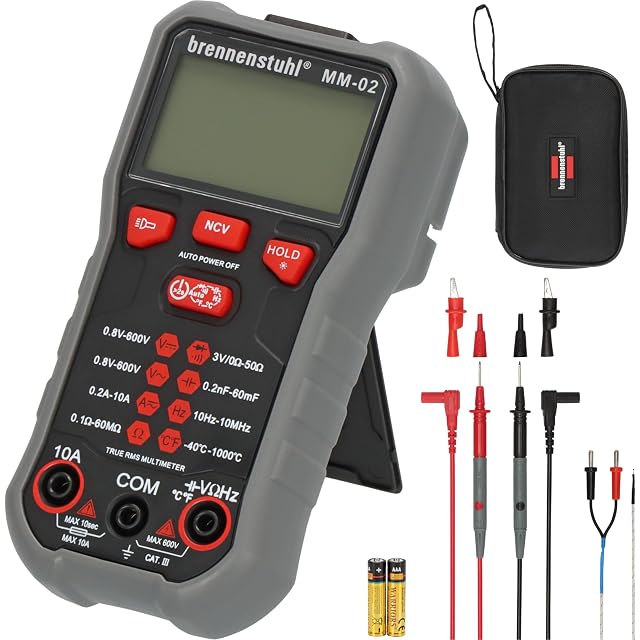
The Brennenstuhl brings true RMS, 6000 counts and the widest function list in its hub. It publishes no category, which is the same gap as almost every meter on this site — read the manual.

Fourth: the clamp

The Voltcraft VC-523 states CAT III 600 V AC/DC in full, with true RMS, eight functions and a built-in contactless detector. That complete rating is what distribution-board and control-cabinet work needs, and it is one of two on this site.

The thing to remember about all four

Prove your tester on a known live source before and after the measurement that matters. No specification substitutes for it.
What we recommend, and why

  1. Brennenstuhl True-RMS multimeter, 6000 counts

    True RMS · 6000 counts · 600 V · temperature, capacitance and frequency

    A true-RMS meter with 6000-count resolution and the widest function list here — voltage, current, resistance, temperature, diode, continuity, capacitance and frequency — with probe caps included.

    Best for: Household and light installation work where waveforms are not clean and the reading has to be right.

    ≈ £35 / 32 €

Questions people actually ask

What does a two-pole tester do that a pen cannot?

It loads the circuit. A phantom voltage induced on a floating conductor collapses under that load, so a two-pole tester distinguishes a live conductor from an induced one. A contactless pen cannot, and it never claims to.

Is a higher CAT number always better?

No — a category describes where an instrument may be used, not how good it is. A socket tester rated CAT II 300 V is correctly rated for a socket outlet, and a higher number would not make it a better tool.

What should I read before the first use?

The manual, for the category and voltage, and for the fuse specification. Both are safety specifications and neither is reliably in the online listing.

The tool we use ourselves

Chosen your tool? Now buy it at the right price.

Thermal cameras, line lasers and clamp meters swing by thirty euros or more across the year, and the biggest "discounts" often land at prices the same model sold for six weeks earlier. UniverTrack tracks the real price history across retailers, spots fake reductions, and alerts you when it is genuinely the moment to buy.

Real price historyBuy-now alertsAI buying assistant
Try free for 14 days →
No commitment · Cancel in one click · 5 languages